
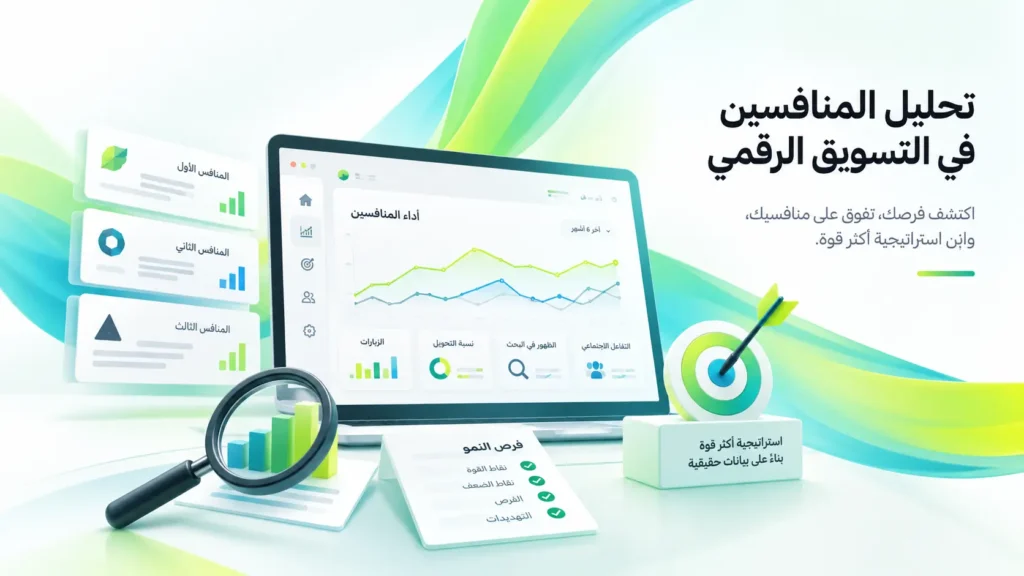
Business excellence is no longer achieved by focusing only on the quality of a product or service. Understanding the market and studying competitors who offer similar solutions has become essential. This is where competitor analysis becomes a strategic practice that provides deeper market insight and supports data-driven decisions. When carried out carefully, competitor insights enable companies to identify opportunities, uncover strengths and weaknesses, and build a structured marketing plan that keeps them ahead of the competition.
What Is Competitor Analysis and Why Is It Essential in Any Marketing Strategy
Competitor analysis is a set of structured practices used to study companies and brands targeting the same audience or offering similar services. It aims to understand their marketing strategies and performance in order to support stronger and more effective marketing plans.
Competitor insights are essential because it helps businesses:
- Understand their current position within the market.
- Identify gaps that can be turned into opportunities.
- Improve the effectiveness of marketing messages.
- Reduce the risks of unstructured decisions.
- Integrate insights into strategy development for better results.
When competitor insights are embedded within your marketing strategy, decisions become more accurate and based on real data rather than assumptions.
Types of Competitors to Study When Starting Competitor Analysis
Before starting competitor analysis, it is important to classify competitors to ensure realistic and useful insights:
- Direct competitors who offer the same product or service.
- Indirect competitors who provide alternative solutions.
- Potential competitors who may enter the market in the future.
This classification improves the quality of competitor insights and allows businesses to focus their efforts based on each competitor’s impact.
How Competitor Analysis Helps You Understand the Market and Make Smarter Decisions
Competitor analysis helps businesses understand the types of services offered in the market, identify trends, and recognize customer preferences. Through market competitor insights, companies gain insights that support smarter decision-making.
Applying competitor insights enables businesses to:
- Identify high-demand customer segments.
- Understand customer behavior and expectations.
- Develop more attractive marketing offers.
- Adjust pricing strategies based on competition.
- Make informed decisions aligned with real market dynamics.
Market competitor insights provide clarity that helps reduce uncertainty and improve performance.
Key Factors to Focus on During Competitor Analysis
To achieve strong results, competitor analysis should focus on the following factors:
- Products or services offered by competitors.
- Pricing strategies.
- Marketing methods and content quality.
- Website user experience.
- Strengths and weaknesses of competitors.
Careful attention to these elements ensures that competition analysis leads to actionable insights and better outcomes.
SEO Competitor Analysis as a Core Part of the Process
Website competitor analysis plays a major role in improving search engine performance. By analyzing competitor websites, businesses can identify target keywords, evaluate content performance, and understand backlink strategies that improve rankings.
From an SEO perspective, competition analysis helps to:
- Discover new keyword opportunities.
- Improve website structure and visibility.
- Create content aligned with search intent.
- Increase search engine rankings.
Website competition analysis offers a clear competitive advantage when used effectively. Check this article to learn more about SEO competitor research and its impact on a company’s development.
The Role of Social Media in Competitor Analysis
Social media competitor analysis provides valuable insights into how audiences interact with brands. It helps identify the most engaging content, the least effective content, the best posting times, and audience preferences.
Through social media competition analysis, businesses can:
- Improve content strategy.
- Build stronger relationships with their audience.
- Increase engagement across platforms.
- Strengthen brand identity over time.
This type of competition analysis provides real data that supports more accurate marketing decisions.
Using Paid Advertising Within Competitor Analysis to Increase Sales
Paid advertising becomes more effective when integrated into competitor analysis. By observing competitor campaigns, businesses can understand messaging strategies, offers, and targeting approaches.
Competitive analysis in this context helps to:
- Test ideas quickly and efficiently.
- Improve advertising performance.
- Reach targeted audiences more precisely.
- Increase conversion rates.
- Achieve more stable returns.
Combining paid advertising with competitor analysis leads to faster results and better performance. Learn more about how to create successful paid campaigns by reading this article.
Best Tools for Competitor Analysis
Using professional tools improves the accuracy and efficiency of competitor analysis. Common tools include:
- SEO analysis tools
- Website competitive analysis platforms
- Social media monitoring tools
- Advertising analytics tools
These tools help businesses perform competitor analysis effectively and uncover new opportunities in the market.
How to Turn Competitor Analysis Into a Successful Marketing Plan
The value of competitor analysis lies in turning insights into actionable strategies. After completing competitive analysis, businesses should:
- Identify their strengths and weaknesses.
- Develop targeted content that meets audience needs.
- Improve user experience.
- Build marketing campaigns based on data insights.
A well-executed competitive analysis ensures that marketing plans are practical and aligned with real market conditions.
Common Mistakes in Competitor Analysis
Even though competitor analysis is essential, certain mistakes can reduce its effectiveness:
- Focusing on a limited number of competitors.
- Copying competitors without adding unique value.
- Ignoring data and relying on assumptions.
- Failing to update the analysis regularly.
- Neglecting the importance of continuous evaluation.
Avoiding these mistakes helps maintain the effectiveness of competitor analysis over time.
We may conclude that competitor analysis is one of the most important steps in building a strong digital marketing strategy. Businesses that rely on competitive analysis consistently gain deeper market understanding, make informed decisions, and strengthen their competitive position.
When used correctly, competitor analysis becomes more than a research tool. It turns into a continuous source of growth that helps businesses adapt to change and achieve sustainable success. Companies that invest in competitive analysis are better positioned to grow steadily and compete effectively in a constantly evolving market. Taiff supports businesses by providing structured solutions that enhance performance and expand digital reach.
Book a consultation with Taiff marketing experts.
Frequently Asked Questions
1.What is the main goal of competitor analysis?
The goal is to understand the market and competitors clearly in order to build more effective strategies.
2.Should competitor analysis be done only once?
No, it should be conducted regularly, especially when launching new campaigns or entering new markets.
3.What is the difference between market competitor analysis and social media competitor analysis?
Market competitor analysis focuses on overall market positioning, while social media competitive analysis focuses on audience interaction and engagement.
4.Can a strategy rely only on competitive analysis?
No, it should be combined with audience research and internal data for better results.
5.What is a key success factor in competitor analysis?
Combining SEO insights, content evaluation, and audience behavior analysis is essential for success.